Monday, June 30, 2008

Relying on 1

Tiger Woods left Nike high and dry after knee injuryTiger Woods is out for the season.

What star teams lose their star player midway through a season, it usually means regrouping and pulling in some talent from other teams or the minor leagues in hope of a spark in the player's absence. In the case of golf, no one can come close to replacing Tiger.

Forget the trophies and the prize money. Heck even forget the fans for a minute. The biggest losers are the sponsors. Tiger makes more money (over $100 million) on sponsors than any other athlete on the planet. When he can't wear his Nike visor and drive around in his Buick, those sponsors are throwing their money away. Without the star in a league of nameless faces, tv sponsors and advertisers are quickly leaving. Live event ticket sales are dropping. Golf is in trouble.

Golf's Problem
They relied on one man to carry their entire operation. Nike relied on one golfer to sell their golf clubs and advertisers only want to place big dollar ads when Tiger was putting on Sundays.

Golf is bigger than Tiger. Yea, he kicks ass and wins like no one Gen-Y has even seen (yes, he's better than Mike), but no one has even tried to compete in a way that rivals Tiger's popularity. Why doesn't Nike have a push for a 2nd golfer? They have an abundance of Basketball, Baseball and Football players all getting the same air time as Mr. Woods. And, actually their bigger stars in those sports don't win anything close to what Tiger does (A-Rod? Kobe? Chad Johnson?). Ok, maybe some MVP's, but no champions like Tiger's a champion.

The Problem With 1Having no backup plan puts you at 1 vs 100
As an entrepreneur, working one idea at a time puts you at a huge disadvantage. If that idea fails, then you have wiped yourself fresh out of the game. No more endorsements and advertisers. Financial backers won't rush to give you more money anytime soon. On the other hand, if you come into the game with multiple options, you have more room for more successes and ultimately more failures.

Even with one product, you need to have multiple layers for which you can get your fans, users and advertisers involved. We are launching a Facebook Application in the next few days (more to come later this week!!) and I'll break it down to you like this:

Monetization:
Affiliate revenue
Direct selling of sponsored placement
Ad Network
Cross promotion with interactive site

For Users:
4 levels of interactivity

  1. What you do
  2. What your friends do
  3. What everyone does
  4. How you compare
We are allowing for multiple layers to give an ultimate experience for everyone involved. If our affiliate revenue is not doing so hot this week, we have backups in the other forms of advertising. If a community member doesn't want to import their own data, they can see their friends data and integrate that into their profile and so on.

The idea of multiple streams of income is nothing new. Even the idea of spreading your message across multiple platforms - print, tv, internet, social media and so on is a marketing no brainer.

The more opportunities you give yourself to succeed, the higher that probability becomes.

How others do it:
Grooveshark - They not only came out with the Grooveshark platform and network, they then introduced Grooveshark Lite and now Tiny Song. In doing so, Grooveshark is effectively creating more opportunities for themselves to not only showcase Grooveshark but to service the different needs of music lovers.

Doterati - This is a new Central Florida Interactive Marketing and Tech association that is giving value to not only the members of the community, but also to the sponsors and companies that wish to be a part of this growing demographic. The value comes in the form of an online resource center including training, a job board, video archive, a Wiki, blog postings as well as traditional networking events, live speakers, meet and greets, panel discussions and other activities. It offers the community multiple points of entry and access.

Don't Follow in NIKE's Footsteps
Nike is left high and dry after losing Tiger for the season. If you lose a key component, player, developer or financial partner, what effects will that have on your business?

By creating 2 star players, you not only give yourself that back up plan, but you give yourself 2 chances to win the title. If Nike began to brand a Phil Mickelson, Vijay Singh or whoever as a top tier player, give them the "Tiger Push," they would have double the coverage and double the chance for their hats, t-shirts, clubs and balls to be center stage on Sunday afternoons. As it goes now, they will have to rely on a comeback tour sometime next spring when Tiger's knee recovers.

Do you have a Tiger Woods project, that will kick ass, season in and season out? What happens when that no longer works, what do you do then? Are you waiting until it is too late? Let me know in the comments. I'd love to hear what you are doing!

-Greg Rollett

Friday, June 20, 2008

The Flip-Flop Kids and Project Management

Design for your users, the flip flop kidsphoto by jspad

Web 2.0 enthusiasts, start-ups and even early adopters are all heavily involved in their projects and how the web revolves around their world. That's cool. They have every right to be.

The rest of the planet, however, is using these tools is a completely different light, or may have not yet even seen the light. I admit to get caught up in the over analysis of new products nearly everyday. The buzz of product "a" is undeserved because product "b" does it better and faster and so on.

What about User A vs User B
In one of my latest meetings we were talking about integrating OpenID or some other form of log-in system that will make things easier for the user. I think this is brilliant, that may also be because I belong to more online communities than most everyone I know.

For User B, or the mainstream population, being a part of OpenID or Plaxo or whatever is still another site for them to manage and be a part of, keep updated and, well, know how to use.

My Wife as an Example
She has a Myspace account, posts photos on Photobucket and Flickr, built a community around our wedding (aww how cute), has log-ins for her computer at work, her work email, her personal e-mail, AIM, T-Mail (stupid Sidekicks will be obsolete on July 11th she says), and I'm sure possible others.

That's a lot of data to remember. But she does it. She is not a Social Media leader or influencer. She has never complained about password or Social Networking fatigue. In fact, she still signs up for stupid travel deals, and well some of them actually work.

Hitting Mass Appeal
Did you hear that I said Myspace is her number one thing. That's because it has reached mass appeal. Notice how I didn't mention Twitter. It hasn't to people like her and many others.

The problem
I think a lot of start-ups have a closed minded view of the overall assessment of their site, software, application, etc. Myspace is far from perfect, but it does everything most people want it to. It connects them with friends, allows you to look at pictures, comment on things, watch video and find and listen to kick ass bands.

Most early adopters hamper on little things like Friend Feed implementation, or Twitter integration as a sign of something being cool or uncool. They say that the interface is not clean enough or doesn't function like "website A."

Mass Appeal Reply
Who gives a shit. When I took a backseat today to look at some of the sites I was running I started to look at what someone like my wife was looking at. I took the view of someone that doesn't critique any and everything on the page, they just wanted to use the site, casually. What I saw on this particular site was a great place to do what the site wanted you to do. It didn't want to integrate with today's latest trend. It doesn't want an interface that rivals an iPhone.

It wanted to do one function and it does it good enough to where the average person can dig it. (No, not that Digg.) They can get involved, maybe tell their friends and be a loyal user.

I want those users like that
The user who understands and abuses my service until it can go no further and yet still produces the results it needs. Your product doesn't need to do everything. In fact I encourage your product not to do everything. It gets your focus and attention away from the thing that makes your product great for whatever reason that may be.

The next time you are getting into technical discussions on features, make sure to take the vantage point of your "average" user. Not the super user or Scoble type. I'm talking about the average 16-25 year old who wears t-shirts, jeans and flip-flops to class or work and casually uses your product enough that you don't have to work a desk job.

When you are in the "War Room" who are you thinking about? The early adopters or the flip-flop kids?

The Flip Flop Kids of the Myspace Generation-Greg Rollett
Let's talk on Twitter or Pownce

Tuesday, June 17, 2008

How To Kill Your Own Buzz

Buzz Marketing and how to kill itphoto by leff

In today's over crowded world of everything from bands on Myspace to Applications on Facebook to Digg clones and beyond, getting your product to be truly "buzz-worthy" is not an easy feat. When a company does get the attention of the Social Media elite and possibly even mainstream media, they truly need to capitalize on the traffic, users and site maintenance to ensure that everyone who comes by has a great time and continues to funnel new traffic to the site.

As we have began the business plan situation for jamblr it has been difficult to gauge what our potential "buzz" is going to be. Will we be unhappy with only a few thousand users in the first few weeks/months? Will we have enough money to support a site that doesn't hit the "mass appeal?"

Then I take a look at some companies that had buzz in the last few weeks. Plurk comes to mind. Twitter was disastrous the last few weeks, just utterly bad. Some people started talking Plurk and all of a sudden, half the Tweets I was receiving were from people talking about Plurk. From how cool it is, to how awful it is, to how "not Twitter" it was.

Chickens With Their Heads Cut Off
I then started to think about what was happening at their offices. I would assume that they were running like chickens with their heads chopped off making sure their servers could handle the load. If they went down, well then, they would be no better than the service they were "supposed" to replace.

What about their PR and marketing people? Where were they? No interview with Scoble? Come on, that's a standard now.

All joking aside, doing a quick search for Plurk on Summize, which tracks Twitter queries, will show that there was indeed a demand, and Plurk users were using their competitor to get the word out. Free marketing via users, that's the best kind of marketing in my book.

So to get onto the theme of killing your own buzz, here are some things, tips and ideas that I have been pondering today:
  • Know how to make things happen for yourself - You get attention from attention. Get the attention of someone who matters, tell them about your product/service and then let your product deliver. Word will spread.
  • Prepare for the unexpected. - Plurk knew Twitter was going to go down again sometime. When a competitor goes down, a front page on TechCrunch happens or 60 minutes shows up on a tip, be ready.
  • Prepare in general - A few weeks ago I was interviewed by Jason at Wired Magazine. I wasn't used for the story. I had some interesting points and I think he liked what I had to say, but I couldn't come up with the specifics he was looking for because I wasn't prepared for the situation. Now I am sure that I am up to date and ready for every meeting, happy hour, web chat or video I shoot.
  • Don't Over-hype - I sign-up for enough of these web services that I know suck. Most were over-hyped by the media and some were over-hyped by the client. I really don't care about the services you are going to have, I only care about the services you have now, when I am logged in and you have my attention.
  • It's better to have something now - As frustrated as you can get with developers, sites take time. However there is a fine line between getting something up and making something perfect. When you have some attention, get something online. Gimme a blog, tell me how the site is coming along. Tell me your servers went down. If I am at your site, or you are at mine, I hope that you can find something that will tell you what we're up to. At jamblr we have a blog and a corny video. It should fly with most people long enough to get your email address.
  • Jump - Take chances, send blind emails and make cold calls. This goes back to the first point, but most people are cowards to make the initial contact that will get them closer to their goal or help them get their hype. I am a chicken shit sometimes as well. The end justifies the means every time though.
  • Admit your mistakes - When traffic comes pouring to your site and you have to have a "we're down page," find a way to explain it, for those that want to know. Own up to it.
  • Forgetting about "the list" - We have been taking in emails for jamblr for almost a month now. We have not sent out anything to the kind folks that are giving away information to be a part of a community that doesn't exist and might not until the end of the year. Knowing when to inform them of our status and get them re-involved is a huge aspect of our "buzz marketing" as our users are the focus point of our whole operation.

When you get your 15 seconds of Internet fame be ready for it. It can come at any moment. If you want to help me get a few seconds, please share this story on StumbleUpon or Digg or Facebook or something cooler that comes along in the future. Till next time...

-Greg Rollett

Monday, June 9, 2008

Gen-Y is NOT Your Average Blogger

Gen-Y Blogger vs. Gen-X Bloggerphoto by: new-york-city

Are you surprised? I am not sure that I am. I think the targeted demographic of most blogs is focused on attracting the Internet savvy Gen-Y consumer base, however, eMarketer says the median age of bloggers is a precise 37.6 years old.

Yea, this is 2 straight posts mentioning eMarketer, but the stats and research they provide is awesome. It also lends to topics that make people think. Including me.

Upon reading this I took a look at my RSS Feeds to see who most of the authors were. I took out all the Brazen Bloggers for this study, sorry guys.

I won't go through the whole list but will show some of my favorites and my guess of their generational demographic (and for those bloggers that I make fell old, call me out, it's just a guess)

Brazen Careerist (Career Advice) - Gen-X
Cheezhead (recruiting information and SEO for HR) - Gen-X
Derek Sivers (CD Baby, Music Marketing) - Gen-X
Evolvor Media (Digital Music Marketing) - Gen-Y
Florida Venture Blog (Dan Rua, Florida VC Celebrity) - Gen-X
HypeBot (Digital Music News) - Gen-X
Mashable (All things Social Media) - Mix of Gen-X and Gen-Y
Matt Cuts (Inside the mind of a Google Genius) - Gen-X
Instigator (VC, Entrepreneurship and Social Media) - Gen-X
ProBlogger (Blogging Tips) - Gen-X
Rock For Hunger (Hunger and Homelessness Awareness) - Gen-Y
Scobleizer (Internet Celebrity) - Gen-X
SEO Moz (SEO tips) - Group of young Gen-X'ers
Seth Godin (Marketing Guru) - Gen-X
yPulse (Gen-Y Marketing) - Written by Gen-X with a new Gen-Y assistant writer

Number of Brazen Blogs in my Reader = 8

Assumptions that can be made, which is in no way official, is that Gen-Y may not be ready to lead or give advice for a larger audience. The authorities on the web are the people who have the jobs that Gen-Y wants.

We do not have the experience that most people in those shoes have. The Gen-Y and Millennial leaders who are reaching out with their voice to an influx of people are the ones who either:
  • Have worked under a great Gen-X leader
  • Work for a great Gen-X leader
  • Work with a great Gen-X leader
  • Have some great mentors, internships, etc with successful people and business professionals in Gen-X
This is not to say that Millennials do not have a voice that can impact change. It's just that most of this generation is not ready to be a leader. Gen-Y cannot bark out commands, hold crowds, be inspirational with their words, nor lead teams without the experience of working with those that have been there before us.

Yes, the business landscape is changing. Yes, Mark created Facebook at 20 or something close to that. But as a businessman, Facebook is NOT making money. Great ideas do not always equal money in the bank.
Great ideas + a great business strategy + great leaders = possible success.

This is why Gen-X is the median age of a blogger, because they are in a position to teach us something. They are in a position to share their experiences, failures, successes and so on. And we listen. In the eMarketer article it showed that 55% of millennials (ages 13 to 24) surveyed read a blog. We want to know what the leaders of today know so that when our time comes we will be educated and prepared.

Gen-Y will change the world, but Gen-X is changing it right now.

If you are Gen-Y, who are you learning from? Gen-X'ers, who do you want to teach, better yet what can you teach? We want to learn!

-Greg Rollett

Friday, June 6, 2008

Gen-Y Demographics

Great stats on Gen-Y from eMarketer:

We spend a lot of money:

We shop online. Nearly half of Gen-Y bought something online in the last 12 months.

Gen-Y is ethnically diverse:

  • 60% white
  • 15% black (non-Hispanic)
  • 18% Hispanic
  • 4% Asian
To compare the baby boomers are:
  • 72% white
  • 11% black (non-Hispanic)
  • 10% Hispanic
  • 4% Asian
Millennials play video games. Nearly everyday. XBox owners do play everyday.

Quick observations:
  • Gen-Y will make more money and will spend more money. We do have a knack for material things and will spend and spend until we have them all.
  • Advertisers need to reach Gen-Y over multiple mediums, in a way that is not obstructive to what they are doing. Brand recognition is key and the more times we see something the more likely we are to remember it. This also has to do with Gen-Y being the ADD Generation.
  • Advertisers need to reach more and different backgrounds, household sizes, interests and cultural differences that ever before. Look at the Rachel Ray / Dunkin Donuts fiasco.
  • Make games. Make then funny, bloody and urban. We dig that stuff.
-Greg Rollett

Thursday, June 5, 2008

How Fast Are You?

image by josef.stuefer

Between instant messaging, Twitter, all the real time Social Media monitoring tools, mobile and even cable companies with DVR boxes and Smart remotes, how fast is your business?
  • How quick can you respond?
  • How fast can you engage your customer/fan/client?
  • How fast till the project is done?
  • How fast till you know someone is talking about you?
  • How fast till you do something about it?
I saw today that Verizon is showing off some tools at movie theaters, where you text in a reply, watch a commercial or video promoting a Verizon product and then all the results of the texting show up on the movie screen. That's fast.

I mentioned that Grooveshark answers their fans near instantly.

In a recent campaign, I wanted my client to play pop culture text message trivia with patrons while the waiter or server got their drinks and put in their order. You don't have to wait. You don't have to go home and enter codes. You play at the table with your phone. If you win you get a coupon that you can use instantly. Not on your next visit. Not on certain dates in the future, instantly.

Clients are impatient. They want to know when their product is ready, but they want it ready faster than you can produce it. Show them things. Make them feel the project is getting closer to having their hands on it.

Clients also want results. They also want them today. They want traffic and conversions now. Is the content you are creating Digg worthy? Is the traffic Digg brings results worthy?

Mark Krupinski and I have been talking about Social Media Measuring tools. We did this over a conversation and then on Twitter. Within minutes, Mark had set up demos with Radian6 and Techrigy.

On my end, Radian6 started following me on Twitter before I knew they existed. They proceeded to join Doterati, a Central Florida Interactive Marketing Community I am helping to build and market. The CEO then sent a direct Tweet to me.


Let's quickly add that I got a comment on my last post from someone at Collective Intellect, another Social Media monitoring too. It's good to see all these companies using FAST as a selling point.

That's fast!

How fast are you?

-Greg Rollett

Wednesday, June 4, 2008

Know the Social Media Audience

Jumping on the Bandwagonphoto by sadaiche

There are a lot of people jumping into Social Media. Setting up Twitter pages, Facebook groups, jumping into FriendFeed or whatever the latest gimmick or hot spot is. I like to think that they coming for the right reasons. To be a part of a community of like minded professionals, to chat with friends, to meet people that share similiar hobbies, interests, etc or even to talk about their accomplishments to people that opted in to listen.

The problem most companies, business or individuals face is that they enter the club without knowing what crowd is there.

Imagine walking into a night club expecting to see a rock band:
  • You get to the parking lot (the homepage | landing page)
  • You wait in line (get the super secret ALPHA or BETA invite code)
  • You pay the cover charge (Fill out their sign-up paperwork)
  • Walk inside and start ordering 2 for 1's, only to realize that they don't serve alcohol and play a style of music that you don't find too appealing. (SEO's on Digg, Pedafiles on Myspace, etc)
  • Instead of going somewhere more suitable you start talking to the girls at the bar, they walk away, you walk back up, they walk away, you walk back up and so on and so on (SPAM, SPAM and more SPAM)

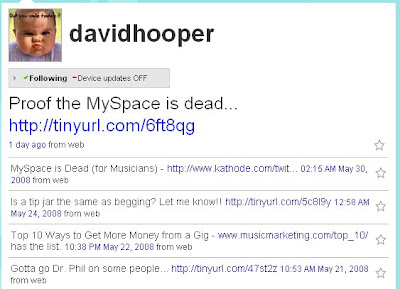
This is my problem with a lot of the marketing going on with Twitter. My latest case in point is Music Marketer David Hooper. I think most of his articles are good and offer value to his readers. I had a problem though with his latest e-book on Twitter for musicians.

I value Twitter, and the relationships that I have on the site. I agree that being an early adopter gives you an advantage and extra vision before the bandwagon comes in. Where I disagree is the fact that Hooper is not a good Twitter user. In fact, he doesn't follow anyone. He does not participate in conversation. He does not use a tracker to see conversations about his own name, let alone music marketing conversations that are happening across the platform. Oh, and the link spam is just awesome.

David Hooper TwitterTwitter Link Spam
If you do not understand the platform, do not tell others to abuse the system. It will destroy the community that Ev Williams and Biz Stone have created and that so many of us love. You cannot "master Twitter in 10 minutes a day." If you think so, you are missing the conversations. You are not getting to know your fans, your peers or witness the beauty of the site. It's just blind, waste of time promotions.

With all Social Networks and Social Media sites, you need a 2-way conversation. Where Myspace failed was not in its crappy architecture, it was in the users who abused it for promotion, and the bigger bands who never wrote back, kept their site static and had a 1-way conversations with their fans.

They pushed out news. They pushed out shows. They NEVER listened.

Before you walk in the club, find some people who go there. Find users who use the site and get results and conversions.

Grooveshark is a company that gets Twitter. Andrew Wise, their business relations partner, has his ears glued to every mention of the work Grooveshark, and is sure that within minutes there is a response made.

I remember saying that I was looking for an oldie on Grooveshark via a Tweet, and within seconds, a message from @Grooveshark asked if I found what I was looking for.

The key to Social Media is to listen. Are you listening?

-Greg Rollett

Monday, June 2, 2008

Lunch With Penelope


I got to the hotel a little before 1. She didn't answer her phone. Oh crap, I got stood up by Penelope Trunk.

Have no fear, a few minutes later we were sitting in the hotel restaurant talking everything from the Brazen Careerist Network to my current and future goals and aspirations to employers and why they don't get Social Media yet.

Here are some key takeaways from the chat.

1. Penelope in real life is nearly identical to Penelope the blogger. The way she brands herself online and the way she presents herself in reality compliment each other to where one is an extension of the other. When companies or individuals look to blog or participate in Social Media they need to keep it real. Write how you talk. Be honest. Talking online and engaging in conversation with others through your blog and social media should come from a real voice and not someone that you made up or hide behind.

2. Narrow your focus.
This was just the kind of straight up advice I would expect from PT and I got it. Paraphrased:

Greg, narrow your focus. Become an expert in one niche or industry and kill it.
While this advice sucks for all the madness that I find myself involved in, it makes more sense than I can argue against. It also makes sense for anyone or any business that is looking to get ahead fast. The advice is so obvious, almost everyone overlooks it and over works themselves. We take on as many projects as we can, spread ourselves super thin and hope that one takes off, instead of kicking ass and taking names in the one thing we are passionate about, building it up and becoming great.

Which leads into number 3.

3. Why can't we let our past go? Penelope has volleyball. I have the music thing. PT longed for a moment at the beach while in Florida to hit the ball around and be back in the mind frame of a pro volleyball player. As for myself, I keep playing shows, and hoping that one day I can use my connections and all that good stuff to have a career in the music business, even though I know I am past my prime and have developed into a better player behind the scenes.

It's tough giving up your past. Maybe sometimes its best to embrace it and build something around it.

4. There is a separation between companies that get Social Media and those that still can't check their own email. The Brazen Careerist Network is made up of over-achieving 20something bloggers who all long for something better than entry-level cubicle hugging opportunities. We all embrace Social Media in some shape or form. Some stop at blogging, others are early adopters using FriendFeed, Pownce, and the hordes of other sites sprouting up everyday.

Employers and companies have an even broader spectrum of knowledge of online tools. Some companies like McDonalds have integrated Facebook into their recruiting campaign. Others are jumping on the video wave to tell their story. There are others still that don't even have websites, and rely on job boards to tell the story of their company to job seekers.

Penelope's master plan:


Gen-Y will change the way companies recruit and communicate and Brazen Careerist will be on the forefront of that change.


If PT comes to your town, take her up for lunch or happy hour. It is one hour that you will never forget. Their was never an awkward moment and she was someone who actually listened, even if my ideas sucked or she thought what I was doing was stupid. Luckily, I do not think she thought either.

Plus she picked up the bill. What a date!

Greg Rollett

Recent Posts

I just claimed my blog on Viralogy.com - #77

ypblogs.com

  © Blogger template 'Isfahan' by Ourblogtemplates.com 2008

Back to TOP